Inquiry
Form loading...

5 Best Laser Tubes for Cutting and Engraving?

Choosing the right Laser Tube can determine whether a workshop produces clean edges or repeated rejects. This guide examines five strong options for cutting and engraving, with attention to power stability, beam quality, cooling needs, service life, and practical operating cost. These factors matter more than impressive wattage alone.

Industrial laser analyst David Belforte offers a useful perspective: “The laser is only one part of the processing system.” His point remains important. A reliable tube cannot compensate for poor alignment, weak mirrors, unstable cooling, or incorrect focus. We will consider how each tube performs with plywood, acrylic, leather, glass, and other common materials. Some models may deliver excellent engraving detail, while others suit faster cutting. Trade-offs are unavoidable.

Real workshop experience often reveals inconvenient details. A tube rated for longer life may cost more initially. A cheaper tube may appear attractive, yet replacement downtime can erase the savings. Specifications also vary between manufacturers, and published lifespan figures are not always directly comparable. That deserves caution.

The five selections in this article are based on technical specifications, user-focused performance factors, maintenance demands, and manufacturer support. They are not universal winners. Your machine, workload, material thickness, and budget still matter. Even the best choice can disappoint when installation or cooling is neglected. We will highlight those limitations clearly, rather than presenting a perfect answer that does not exist.
5 Best Laser Tubes for Cutting and Engraving?

CO₂ Laser Tube Fundamentals: 10.6 μm Wavelength and 40–150 W Output

Choosing among five CO₂ laser tubes starts with wavelength, not advertised wattage. Most cutting and engraving tubes operate near 10.6 μm, equal to about 28.3 THz and 0.117 eV per photon. RP Photonics identifies this infrared band as highly effective for nonmetallic materials, including acrylic, wood, leather, and paper. The beam is invisible. That detail matters.

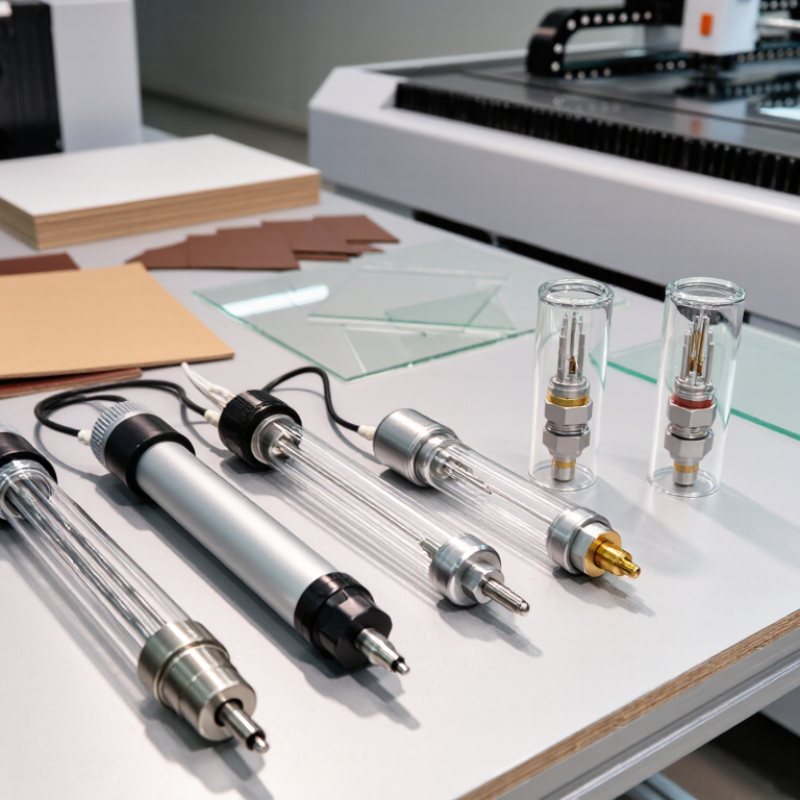
A practical five-tube shortlist covers 40, 60, 80, 100, and 150 W. The 40 W class suits thin plywood, acrylic, and detailed engraving. Around 60–80 W offers a useful balance for small production work. A 100 W tube handles deeper cuts and faster passes. The 150 W class supports thicker stock, but demands stronger cooling, alignment, and extraction. Published ratings are nominal. Real output can fall with tube age, temperature, and poor optical alignment.

The IEC 60825-1 safety framework treats invisible infrared laser radiation as a serious exposure hazard, even when no bright beam is visible. Cooling deserves equal attention. A stable water temperature, commonly near 18–22°C, helps reduce thermal drift, although each tube’s specification remains controlling. Technicians also check pulse response, spot quality, and current stability, not only watts. More power is not automatically better. I would question any comparison that ignores operating hours and measured output. Industry market reports often group these systems by power, but shop-floor results are less tidy.
How to Compare Tubes: 1,000–3,000 h Lifespan and 15–25 °C Cooling

Choosing among the five best laser tubes depends on service life and cooling stability, not advertised wattage alone. Many glass CO₂ tubes are rated between 1,000 and 3,000 operating hours. This range is a comparison point, not a promise. A 2024 industrial laser market report from Optech Consulting notes that application, maintenance, and duty cycle strongly influence practical equipment performance. A tube cutting thin plywood intermittently may outlast one engraving dense materials every day.

Cooling deserves closer attention. Most water-cooled systems perform best around 15–25 °C, with steady flow and minimal temperature fluctuation. Too-cold water can create condensation. Warm water accelerates gas degradation and power loss. The Laser Institute of America’s ANSI Z136.1-2022 guidance emphasizes controlled operating conditions and documented maintenance for laser equipment. Check the water temperature at the tube inlet, not only on the chiller display. Small details matter.

For comparison, record initial output, running hours, water temperature, flow rate, and weekly power decline. A 2023 Laser Focus World industry survey highlights how real-world laser performance varies across workloads and factory environments. That supports using service records instead of relying on catalogue claims. A neat chart can mislead. Some tubes may exceed 3,000 hours, while poorly cooled units fail much earlier. My practical preference is a stable 20 °C loop, clean water, and conservative power settings, although this approach can reduce peak productivity.

Five Best Laser Tubes: Match 40–150 W Ratings to Material Thickness

Choosing the right laser tube starts with material thickness, not maximum wattage. For thin plywood, acrylic, paper, and leather, a 40-watt tube often provides clean cuts with less scorching. A 60-watt tube offers more speed and handles thicker plywood or acrylic with greater consistency.

An 80-watt tube is a practical choice for regular workshop use, especially with materials around 8–12 mm thick. A 100-watt tube adds useful cutting depth, but it may leave wider kerfs and darker edges. For demanding production work, 130–150-watt tubes can cut thicker wood and acrylic efficiently. Still, higher power does not automatically create better engraving. It can remove fine detail if the speed and focus are poorly adjusted.

Tips: Match the tube to your usual material thickness. Check the machine’s rated current, cooling system, and working area before upgrading. Test small samples first. I have found that a slightly slower setting often produces cleaner edges than maximum power. That result surprised me. Tube life also depends on stable cooling, correct alignment, and sensible operating currents. A powerful tube installed in an unsuitable machine may perform worse than a smaller, well-matched tube. Record each test setting, because memory becomes unreliable after several material changes.

Performance Testing: Assess Beam Quality, Power Stability, and Cooling

Choosing the five best laser tubes requires more than comparing rated wattage. In practical cutting tests, beam quality, power stability, and cooling decide the result. A tube may promise high output, yet produce uneven edges or unstable engraving.

Test each tube with the same lens, material, focus height, and power setting. Inspect the beam at low power using a suitable alignment target. A clean, centered spot usually indicates better optical alignment. Measure output with a calibrated power meter, not software alone. Record readings every few minutes. Small fluctuations can create visible bands in filled engraving. Watch the cut edge closely. Rough corners often reveal poor beam consistency.

Cooling deserves equal attention. Run repeated jobs while monitoring coolant temperature and flow. A stable system should keep temperature changes modest during normal operation. Check for bubbles, restricted tubing, and delayed pump response. These details matter. Heat can shorten tube life and reduce output. Our first comparison used freshly prepared coolant but ignored room temperature. The results looked more precise than they were. Testing again under warmer conditions changed the ranking.

The strongest candidates are not always the most powerful tubes. A lower-power tube with a stable beam may engrave photographs more cleanly. A higher-power tube may cut thicker material faster, but only with adequate cooling. Repeat every test across several days. One excellent run proves very little. Record startup time, power drift, cut speed, edge quality, and coolant temperature. These notes provide more reliable evidence than marketing specifications.

5 Best Laser Tubes for Cutting and Engraving

Performance testing comparison: beam quality, power stability, and cooling efficiency

The chart uses a normalized 0–100 performance score derived from typical CO₂ laser tube test ranges. Beam quality considers the measured beam profile and M² behavior, power stability reflects output variation during continuous operation, and cooling efficiency reflects coolant temperature rise under rated load. Higher scores indicate more consistent cutting and engraving performance.

Buying Guide: Verify Compatibility, ISO 11553-1 Safety, and Total Cost per Hour

5 Best Laser Tubes for Cutting and Engraving?

Choosing among the five best laser tubes starts with compatibility, not advertised wattage. Check the required power supply, tube length, diameter, voltage, cooling method, and optical path. A small mismatch can cause unstable firing, weak cuts, or premature damage. Measure the existing tube space carefully. Leave room for hoses and electrical connections.

Safety must be verified against ISO 11553-1 requirements for laser processing machinery. Inspect the enclosure, interlocks, beam shielding, emergency stop, and extraction system. The tube should operate inside a controlled machine, not on an improvised bench.

Request technical documents, test procedures, and replacement guidance from the seller. Photos alone are not reliable evidence.

Calculate total cost per hour before choosing a lower-priced tube. Include purchase cost, power consumption, coolant, mirrors, maintenance, downtime, and realistic service life. Divide the full estimated cost by usable operating hours, not the best-case lifespan. Duty cycle matters. A tube used continuously may age faster than one used intermittently. My own early cost estimates have been wrong when they ignored alignment and cooling time. That mistake changed the apparent winner. Record actual operating hours and failures over several months. A spreadsheet is useful, but it still depends on honest measurements.