Inquiry
Form loading...
The 2026 Top High Voltage CO2 Power Supply Manufacturers guide examines the companies shaping reliable laser power technology. A High Voltage Co2 Power Supply is not merely a voltage source. It controls ignition, discharge stability, beam consistency, and operating safety.
Dr. Eckhard Beyer, a respected laser technology researcher, has emphasized, “Laser performance depends on the stability of every component in the process.” That principle remains practical on a factory floor. A power supply may appear compact, yet it can manage demanding electrical conditions beside a hot CO2 laser tube. Small voltage fluctuations can affect cutting edges, engraving depth, and production rhythm.
This introduction compares leading manufacturers through measurable criteria. These include output stability, ripple control, ignition performance, thermal design, protection systems, efficiency, and technical support. Product compatibility also matters. A supply designed for a 60-watt tube should not be judged like one built for industrial systems above 300 watts.
Real experience often reveals more than a catalog. Engineers check cable insulation, connector quality, cooling paths, and fault-response behavior. Operators notice startup delays first. Maintenance teams notice weak documentation later.
No ranking is perfect. Market data changes quickly. Some suppliers publish detailed specifications, while others provide limited test information. That difference deserves attention.
The strongest manufacturers combine electrical expertise with consistent quality control. They also support customers after installation, when unexpected faults appear during a long production shift. This guide therefore considers performance, evidence, service reliability, and practical value. Readers can use these factors to identify a High Voltage Co2 Power Supply manufacturer that fits their laser system, workload, and long-term operating goals.
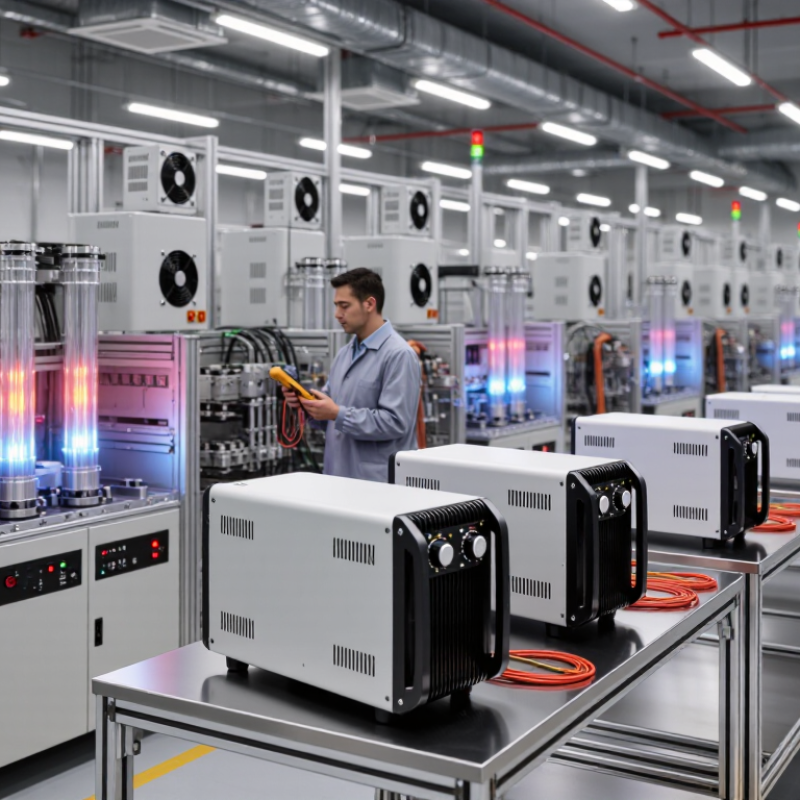
High-voltage CO2 power supplies convert mains electricity into controlled energy for gas-laser discharge. A rectifier creates a high-voltage DC link. An inverter, transformer, and regulating stage then deliver stable output, often from several kilovolts to tens of kilovolts. Inside the laser tube, this voltage excites a carbon dioxide, nitrogen, and helium mixture. Nitrogen transfers energy to CO2 molecules. The excited molecules release infrared radiation, commonly near 10.6 micrometres.
Control quality matters more than peak voltage. Small ripple can change discharge stability, beam output, and tube life. Practical systems use current limiting, soft starting, arc detection, and rapid shutdown. Cooling is also essential. The U.S. Department of Energy’s Industrial Decarbonization Roadmap identifies energy efficiency as a major industrial improvement pathway. That principle applies here: lower electrical losses reduce heat, operating costs, and stress on components.
Market reports often describe industrial CO2 lasers as mature but still important for cutting, engraving, and materials processing. Their figures vary because some studies include sealed tubes, while others include complete systems. The World Meteorological Organization reported atmospheric CO2 at 420.0 ppm in 2023, reinforcing the need for efficient equipment across energy-intensive industries. The comparison is indirect, however. It should not be treated as a laser-market forecast. A further complication remains: RF-excited CO2 lasers use high-frequency power rather than conventional high-voltage DC. Buyers should verify the excitation method, voltage range, regulation accuracy, duty cycle, and protection design before comparing manufacturers.
| Technical Dimension | Typical or Standard Specification | Definition and Operating Principle | Selection Criteria for a High-Voltage CO2 Power Supply |
|---|---|---|---|
| Product Definition | High-voltage DC power converter for sealed or flowing-gas CO2 lasers | The supply converts low-voltage AC or DC input into a regulated high-voltage output that initiates and sustains the electrical discharge inside the CO2 laser tube. | Confirm compatibility with the laser tube's rated voltage, current, power, connector arrangement, and control interface. |
| Common Output Voltage | Approximately 10–40 kV DC, depending on tube length and laser power | A high voltage is required to ionize the gas mixture and create a stable plasma discharge. The exact voltage varies with tube geometry, gas pressure, electrode spacing, and operating conditions. | Use the tube manufacturer's electrical specifications rather than selecting only by nominal laser wattage. |
| Common Output Current | Approximately 5–40 mA for many low- and medium-power sealed CO2 laser systems | After ignition, the power supply regulates discharge current to maintain stable plasma generation. Excessive current can shorten tube life or damage the discharge system. | Choose a current range that includes the tube's recommended operating point and maximum permitted current. |
| Power Range | Typically from tens of watts to several kilowatts | Electrical input power is converted into discharge power and heat. The required rating depends on the optical output power, tube efficiency, duty cycle, and cooling arrangement. | Allow suitable operating margin without greatly oversizing the supply, because poor matching can reduce regulation quality and efficiency. |
| Input Supply | Commonly single-phase 100–240 V AC; larger systems may use higher-voltage or three-phase input | An internal rectifier and switching converter transform the incoming power into a controlled high-voltage output. | Check input voltage range, frequency, maximum input current, inrush current, and compatibility with the installation's electrical system. |
| Ignition Function | High-voltage start-up pulse followed by regulated running output | Ignition requires a sufficiently high electric field to break down the CO2 laser gas. Once the plasma is established, the supply changes to controlled-current operation. | Verify ignition voltage, start-up sequence, pulse duration, and whether the supply supports repeated starting cycles. |
| Control Mode | Analog control, PWM control, digital control, or a combination | The laser controller adjusts current or power through a control signal. Pulse-width modulation is widely used for controlling average laser output in marking and cutting systems. | Match the control method, signal voltage, response time, minimum pulse width, and enable logic with the motion or laser controller. |
| Output Regulation | Closed-loop voltage and current regulation | Feedback circuits monitor output conditions and adjust switching operation to compensate for input-voltage and load variations. | Review current stability, voltage stability, repeatability, control resolution, and response to rapid power changes. |
| Operating Frequency | High-frequency switching, commonly in the tens of kilohertz range | High-frequency switching allows the transformer and filtering components to be smaller than those used in line-frequency supplies, while enabling fast control response. | Consider conducted and radiated electromagnetic interference, switching noise, acoustic noise, and shielding requirements. |
| Cooling Method | Forced-air cooling for compact units; liquid cooling for higher-power systems | Power conversion produces heat in switching devices, transformers, rectifiers, and resistive components. Thermal management keeps components within their rated temperature range. | Check airflow direction, fan monitoring, coolant requirements, allowable ambient temperature, and installation clearance. |
| Protection Functions | Over-current, over-voltage, arc, short-circuit, over-temperature, and interlock protection | Protection circuits disconnect or limit the high-voltage output when abnormal discharge, wiring faults, excessive temperature, or unsafe operating conditions are detected. | Prioritize fast fault response, automatic recovery behavior, fault indication, and compatibility with external emergency-stop circuits. |
| Safety Interlock | Enable, remote interlock, door interlock, and emergency-stop inputs | An interlock prevents high-voltage generation when a machine guard is open, a cooling system is unavailable, or a safety circuit is interrupted. | Use a fail-safe interlock design and verify that the high-voltage output is disabled when the safety loop opens. |
| CO2 Laser Wavelength | Commonly 10.6 µm; some CO2 laser configurations operate near 9.3–10.6 µm | The electrical power supply does not determine the wavelength directly. The wavelength is produced by molecular transitions in the CO2-based gas mixture inside the resonator. | Select the power supply according to the electrical requirements of the specific laser tube, not wavelength alone. |
| Gas Discharge | Electrical discharge in a CO2, nitrogen, and helium-based gas mixture | The discharge excites nitrogen molecules, which transfer energy to CO2 molecules. The excited CO2 molecules generate infrared laser radiation in the optical resonator. | Stable current regulation is essential for consistent plasma conditions and repeatable optical output. |
| Load Compatibility | Sealed glass tubes, ceramic tubes, and industrial RF or DC-excited configurations require different electrical interfaces | Different CO2 laser architectures use different excitation methods. A DC high-voltage supply is not automatically suitable for an RF-excited laser source. | Confirm excitation technology, electrode polarity, cathode requirements, starting method, and feedback signals before purchase. |
| Efficiency | Often approximately 85–95% for modern switch-mode designs, depending on load and topology | Efficiency indicates how much input power is converted into useful output power rather than dissipated as heat. | Compare efficiency at the actual operating point, standby consumption, thermal losses, and power-factor performance. |
| Power Factor | Usually improved with active or passive power-factor correction | Power-factor correction reduces reactive and harmonic current drawn from the AC supply and can improve utilization of facility power capacity. | Check the rated power factor, total harmonic distortion, and compliance with the electrical requirements of the target market. |
| Electromagnetic Compatibility | Designed to limit conducted and radiated emissions while maintaining immunity to electrical disturbances | High-frequency switching and high-voltage discharge can generate electromagnetic interference. Filtering, grounding, shielding, and layout control help reduce interference. | Request EMC test information and verify grounding, cable routing, shield termination, and enclosure requirements. |
| Environmental Conditions | Typical industrial designs support approximately 0–40 °C ambient operation, subject to the product specification | Temperature, humidity, dust, altitude, and vibration affect insulation, cooling, component life, and high-voltage reliability. | Confirm operating temperature, storage temperature, humidity limits, altitude derating, enclosure rating, and contamination class. |
| Insulation and Creepage | High-voltage insulation, adequate creepage and clearance, and insulated output connectors | Physical separation and insulation prevent arcing, leakage current, and accidental contact with hazardous voltage. | Inspect insulation design, output connector ratings, potting or conformal coating, discharge resistors, and service-access provisions. |
| Standards and Compliance | Applicable requirements may include IEC 62368-1, IEC 60204-1, EMC regulations, and regional marking requirements | Safety and EMC standards address electrical hazards, machine integration, emissions, immunity, and documentation. The applicable standard depends on the complete equipment and market. | Request a declaration of conformity, test reports where applicable, wiring diagrams, risk information, and installation instructions. |
| Service Life Factors | Affected by thermal stress, discharge instability, switching stress, dust, moisture, and duty cycle | Stable regulation and adequate cooling reduce stress on both the power supply and the CO2 laser tube. | Evaluate fan or pump serviceability, component derating, maintenance access, fault history, warranty terms, and spare-part availability. |
| Best-Fit Applications | Cutting, engraving, marking, welding, drilling, medical equipment, and laboratory CO2 laser systems | Application requirements determine output power, modulation speed, duty cycle, repeatability, and cooling needs. | Choose a supply based on the complete laser system's operating profile rather than on maximum voltage alone. |